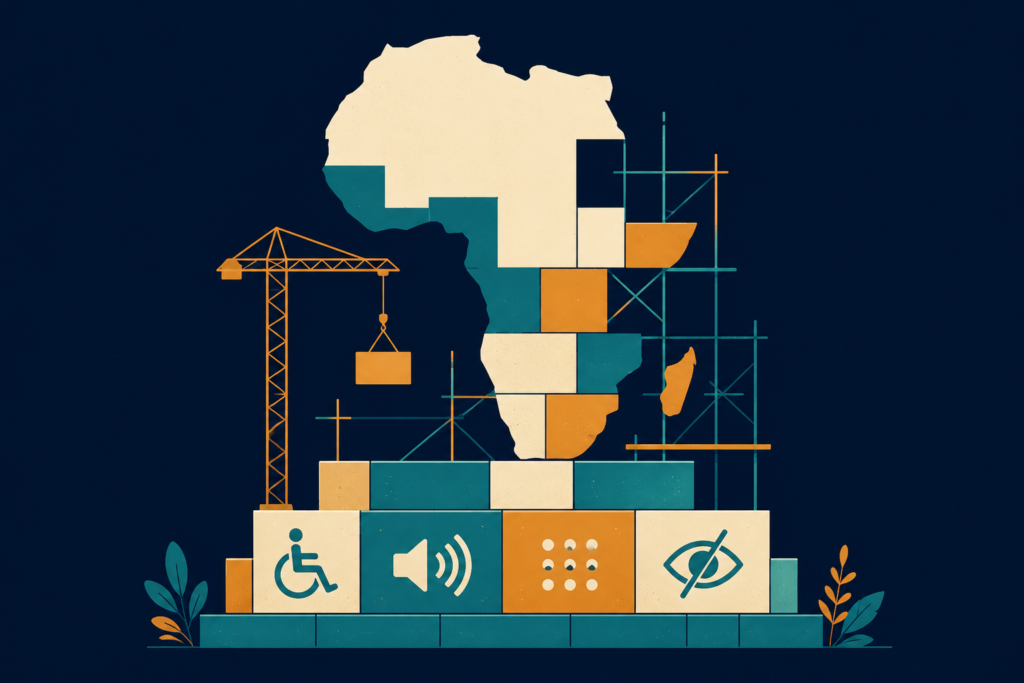
On 18 February 2026, at the Zero Project Conference at the UN in Vienna, inABLE and the African Organisation for Standardisation (ARSO) made an announcement that’s been a long time coming: they’re partnering to build Africa’s first harmonised standard for accessible ICT products and services.
This is a significant development. Africa has never had a continental benchmark for digital accessibility, with every country doing its own thing and most doing nothing at all. Here’s what’s actually been confirmed, what it’s built on, and, because a lot of the coverage has been more cheerleading than scrutiny, what’s still genuinely unresolved.
Background
inABLE’s founder, Irene Mbari-Kirika, put it well: “Standards are the invisible infrastructure of inclusion.” Accessibility doesn’t usually fail because people don’t care. It fails because nobody’s built the underlying systems that make it the default instead of an afterthought. A continental standard is part of that infrastructure.
Per ARSO’s press release, this is a 24-month effort to develop a Harmonised African Standard (HAS) for Accessible ICT Products and Services. The process explicitly involves youth, women, and Organisations of Persons with Disabilities (OPDs) from the start. The standard will be built by adapting existing global accessibility standards to the African context, and once it’s done, all 45 ARSO member states can adopt it.
“ICT products and services” is a much broader scope than people often assume. It’s not just a website checklist, but websites, mobile apps, non-web software, documents, and hardware: essentially anything a government or company might build or buy.
The foundation: KS 2952
Most coverage glosses over an important detail: this isn’t a blank-page exercise. ARSO is going to take an existing standard, Kenya’s KS 2952, and adapt it for the whole continent, under ARSO’s Project Committee 04 (ARSP PC 04) on ICT Disability Access.
KS 2952 is worth understanding on its own terms. It’s Kenya’s national ICT accessibility standard, gazetted in May 2022, the first of its kind in Africa, built by the Kenya Bureau of Standards with inABLE, alongside Kenya’s ICT Authority, Communications Authority, and National Council for Persons Living with Disability. It has two parts: Part 1 lays out functional accessibility requirements, and Part 2 covers conformance, meaning how an organisation demonstrates it meets those requirements, with testing aligned to ISO/IEC 17007 so results are consistent regardless of who’s checking.
KS 2952 already covers software and hardware, web and non-web and hybrid technologies, which closely matches the scope being described for the continental standard, and it already references international standards like ETSI’s accessibility specifications. So this isn’t an attempt to write a world-class standard from scratch in 24 months. It’s adapting a document that already exists, that a government has already adopted, that’s already connected to global frameworks, for use across 45 countries.
That’s a meaningfully stronger starting point than a political declaration with nothing behind it.
The partners
Two organisations are leading this, and their strengths complement each other.
inABLE is a Kenya-based (and US-registered) non-profit, founded in 2009. It started small, with assistive technology labs in schools for the blind and accessible digital hubs in rural Kenya, and has grown into the continent’s leading accessibility organisation, by most accounts. They built KS 2952. They run the Inclusive Africa Conference, the biggest annual gathering of accessibility practitioners on the continent. In 2025 they were named to the inaugural Forbes Accessibility 100 list. On this project, they’re providing technical leadership and funding, with ARSO handling oversight and coordination.
ARSO provides the institutional capacity. Established in 1977 by the African Union and the UN Economic Commission for Africa, it’s the continental body for harmonising standards, currently across 15 sectors and around 100 technical committees, covering everything from pharmaceuticals to food safety to automotive standards. With 45 member countries, it functions as Africa’s equivalent of ISO. What ARSO brings is something inABLE can’t provide alone: a route for turning a technical document into something 45 governments can actually adopt.
inABLE knows what good accessibility looks like and has already built a working national standard for it. ARSO knows how to make a standard function across borders. That combination is well suited to this kind of project.
Timeline
Two further milestones since the original announcement have added weight to the initiative.
In May 2026, at the Connected Africa Summit in Nairobi, fourteen African countries formally signed on at a Ministerial Roundtable on Digital Inclusion. Five have been named publicly, Kenya, Angola, Chad, Malawi, and South Sudan, with the rest unspecified. ARSO’s Technical Director, Reuben Kisore, framed the goal in terms that will resonate with anyone who’s built for multiple African markets: a unified framework that improves interoperability, strengthens consumer protection, and gives African technology a consistent accessibility benchmark across markets, rather than a patchwork of different rules, or none, in each country. Angola’s representative added that aligning with global benchmarks also helps position African-built technology for international markets.
Then, on 3 June 2026, at the Inclusive Africa Conference in Nairobi, under the theme “Accelerating Digital Accessibility and AI Solutions for Africa’s Future,” the development process formally launched. Germany’s development agency GIZ joined as a co-lead alongside ARSO, with inABLE continuing as technical lead. inABLE’s Executive Director framed the stakes directly: with Africa’s digital economy expanding rapidly, the question is whether it’s being built for everyone, or leaving more than 80 million Africans with disabilities behind.
February was the announcement. May brought formal commitment from a substantial group of countries. June was the start of the actual development work, with GIZ’s involvement signalling funding behind the project beyond inABLE’s own resources.
Open questions
A lot of the coverage so far has read more like a press release than an assessment, so it’s worth being clear about what hasn’t been settled.
The full list of 14 countries hasn’t been published. Five names are public; the other nine remain unknown. South Africa’s participation is, as far as can be determined, unconfirmed: it doesn’t appear in any of the public coverage of the May announcement. SABS, South Africa’s standards body, is an ARSO member, so a channel for participation exists. Whether South Africa is part of this specific process is a separate question, and there’s currently no public answer to it.
“Adapted to the African context” is, for now, a commitment rather than a specification. The press release states clearly that the standard will reflect Africa’s realities: infrastructure limitations, linguistic diversity, and inconsistent connectivity. That’s an important commitment, but it describes the process rather than the output. What does “accounting for low connectivity” translate to as an actual requirement? What does accessibility look like for a government service accessed over USSD on a feature phone, in a language with little or no assistive technology support? These are the questions the 24-month process is meant to answer, and they remain open.
The 24-month timeline is a target rather than a guarantee. Counting from February 2026, that points to a draft standard around early 2028. Multi-country standards processes, particularly those involving national bodies with widely varying capacity, tend to take longer than initially projected. That’s not a criticism of this specific project so much as a general pattern in this kind of work.
A published standard is not the same as an enforced one. Once the Harmonised African Standard exists, each of the 45 ARSO members would still need to incorporate it into national law, regulation, or procurement requirements for it to carry legal weight, which means 45 separate processes on 45 separate timelines. Europe’s EN 301 549 is a useful comparison: it existed for years before the European Accessibility Act made it mandatory, with that enforcement only taking full effect in June 2025. The gap between a standard existing and a standard being enforced can be substantial.
The “80 million” figure comes from inABLE and hasn’t been independently sourced. It appears throughout their materials, but isn’t tied to a specific WHO study or census figure that could be located. For context, WHO’s 2023 global estimate puts roughly 1 in 6 people as living with significant disability; applying that ratio to Africa’s population of around 1.4 billion would suggest a considerably higher number than 80 million. The figure likely reflects a narrower definition of disability. That doesn’t make it inaccurate, but it’s worth understanding its origin before citing it as an established statistic.
Why it matters
None of the above is a reason to be dismissive about this project.
The web, globally, remains largely inaccessible. WebAIM’s 2025 Million report, an automated scan of the top one million homepages, found that 94.8% had detectable WCAG 2 failures, averaging 51 errors per page. That’s only a slight improvement on 95.9% in 2024, and the six-year trend shows failure rates dropping by roughly three percentage points since 2019. This is the picture in markets with mature accessibility law, established tooling, and years of advocacy behind them. Africa, without a continental standard, hasn’t had even that reference point.
That’s the gap this project is addressing. It won’t resolve everything: a standard doesn’t rewrite procurement practices or train a generation of auditors on its own. But a standard is the foundation everything else gets built on: it’s what a procurement officer references in a tender, what an auditor tests against, what a training course is structured around. Most of Africa currently lacks that foundation. This project is a genuine attempt to build one, based on a document that already exists, led by the organisation that built it, with institutional backing that could turn it into something 45 governments use.
Whether it lands on schedule, whether South Africa is involved, and what “African context” ends up meaning in practice are all still open. But relative to most continental policy announcements, this one starts from an unusually solid position, and it’s worth following closely over the next couple of years.
What’s next
A few things worth tracking:
Procurement language. The clearest sign of a standard gaining real traction is governments writing it into tenders. Watch for accessibility requirements appearing in ICT procurement specifications in Kenya and the other named countries over the next 12 to 18 months; that will be more informative than any further announcement.
The Technical Committee convening. ARSP PC 04 is where the actual development work happens. When it formally convenes, and if it opens any form of consultation, that’s when the question of what “African context” means in practice will start to be answered.
Whether South Africa becomes involved. SABS’s participation, or lack of it, in ARSP PC 04 is the detail to watch for South African practitioners. If there’s a route for local input into a continental standard, it runs through SABS.
Direct updates from ARSO and inABLE. Both organisations post updates: ARSO at arso-oran.org and inABLE at inable.org. Given the pace of developments so far (February, May, June), further milestones before the end of 2026 seem likely.
None of this changes what’s worth doing in the meantime. WCAG 2.2 AA remains the global baseline, and it’s what KS 2952, and most likely whatever emerges from this process, builds on. Organisations building accessible products now aren’t waiting for a continental standard to do so; they’re simply ahead of where it will eventually land.
Comments
Loading comments...